Finding the Hypotenuse

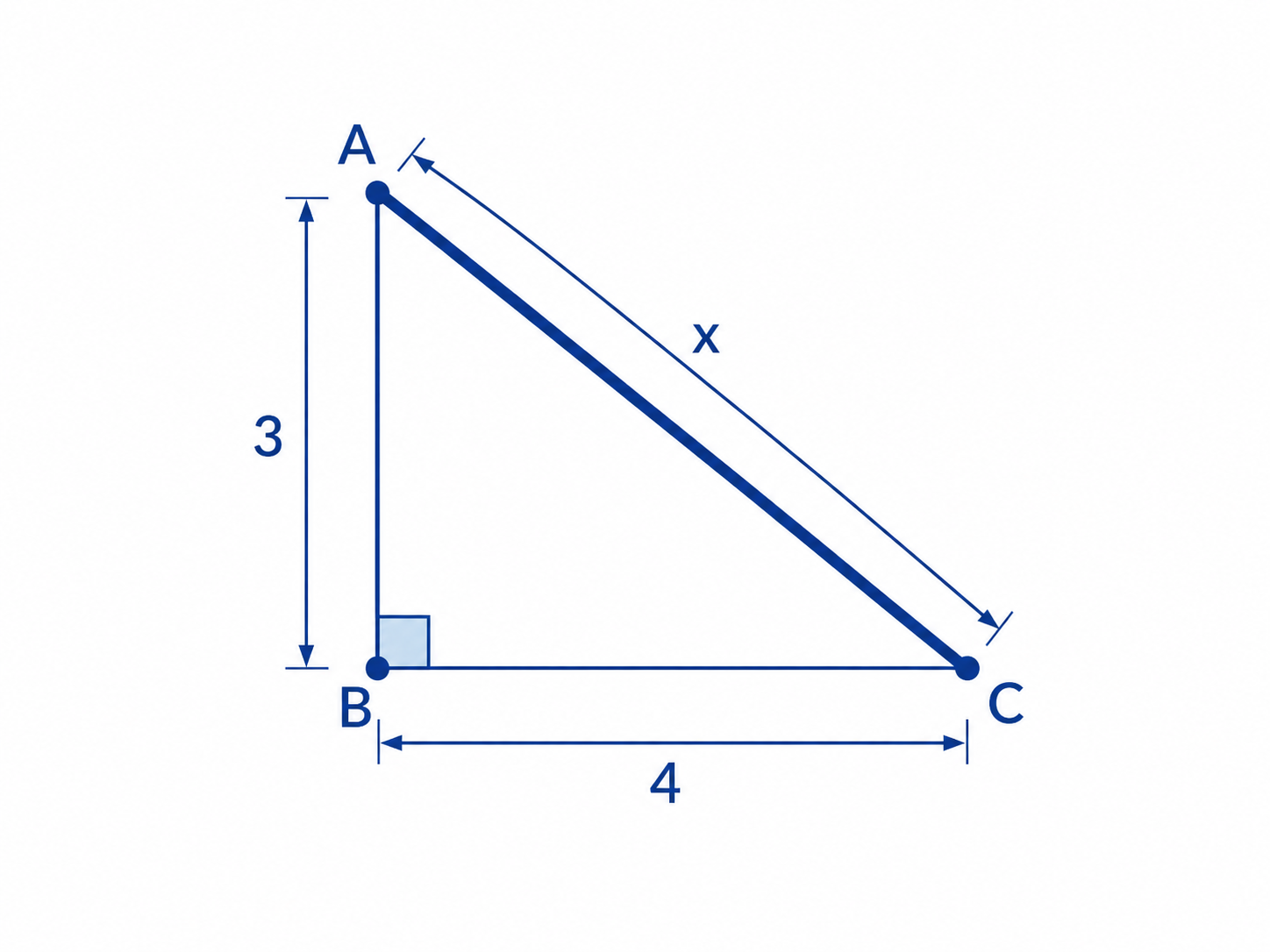
Triangle $ABC$ is right-angled at $B$, with legs $AB = 3$ and $BC = 4$. The hypotenuse $AC$ is marked $x$.
Principles it rests on
- Pythagorean Theorem: In a right triangle the square of the hypotenuse equals the sum of the squares of the two legs, so the hypotenuse is the square root of that sum.
- Ordering: The hypotenuse is strictly longer than either leg and strictly shorter than the sum of the legs, which provides a quick check on any answer.
- Pythagorean Triples: When the legs are integers the hypotenuse often is too, and the general form $(m^2-n^2, 2mn, m^2+n^2)$ generates every primitive solution.
Question
What is the length of the hypotenuse $x = AC$, in units?
Hints
Solution
1. Pythagoras:
In a right triangle, the square of the hypotenuse equals the sum of the squares of the legs: $AC^2 = AB^2 + BC^2 = 3^2 + 4^2 = 9 + 16 = 25$
2. Take the square root:
$AC = \sqrt{25} = 5.$
3. A useful check: the hypotenuse must exceed each leg but be less than their sum, and $5$ satisfies $5 > 4$ while $5 < 7$.
4. Answer: $x = 5$.
How others did
Nobody has tried this yet.Be the first. Your answer starts the stats.
Only each person's first answer, given before viewing the solution, is counted.


Discussion 0 comments
Log in to join the discussion.