Zeno's Paradox Geometric Series

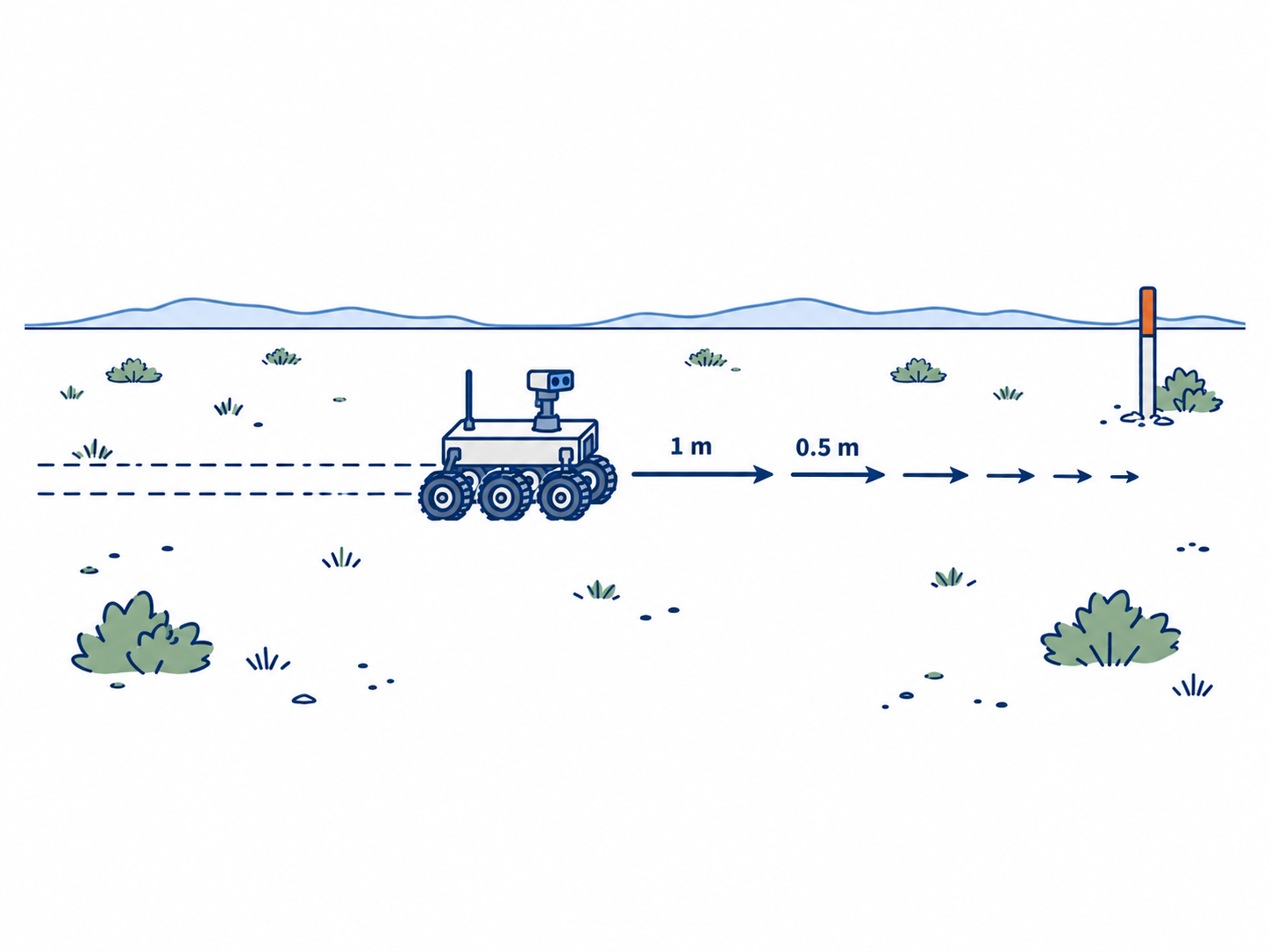
An autonomous robotic rover travels in a straight line toward a target marker. In step 1, it moves 1 meter. In step 2, it moves 0.5 meters. In each subsequent step $k$, it moves exactly half the distance of the previous step ($(\frac{1}{2})^{k-1}$ meters).
Principles it rests on
- Geometric Series Formula: A series with first term $a$ and common ratio $r$ sums to $S_N = a\frac{1 - r^{N}}{1 - r}$, with $S_\infty = \frac{a}{1 - r}$ when $|r| < 1$.
- Convergence Criterion: An infinite series converges precisely when its terms are driven toward zero at a sufficient rate; otherwise the partial sums diverge.
- Limits of Partial Sums: For a convergent series the total is defined as the limit of its partial sums, which need not agree with any intuition about how the terms behave.
Question
If the rover continues this infinite sequence of steps indefinitely, what is the total theoretical distance traveled in meters?
Hints
Solution
1. Formulate the Discrete Step Sequence:
Let $d_k$ denote the distance traveled on step $k$ (where step indexing begins at $k = 0$):
- Step 1 ($k=0$): $d_0 = 1\text{ m}$
- Step 2 ($k=1$): $d_1 = 0.5\text{ m} = \frac{1}{2}\text{ m}$
- Step 3 ($k=2$): $d_2 = 0.25\text{ m} = \frac{1}{4}\text{ m}$
- Step $k+1$: $d_k = a \cdot r^k = 1 \cdot (\frac{1}{2})^k\text{ m}$
This forms an infinite geometric series with initial term $a = 1$ and common ratio $r = 0.5$.
2. Derive the Partial Sum Formula from First Principles:
Let the sum of the first $N$ steps be $S_N = \sum_{k=0}^{N-1} a r^k = a + a r + a r^2 + \dots + a r^{N-1}$.
Multiplying both sides by the common ratio $r$:
$r S_N = a r + a r^2 + a r^3 + \dots + a r^N$
Subtracting $r S_N$ from $S_N$ causes all intermediate terms to cancel telescopically:
$S_N - r S_N = a - a r^N \implies S_N(1 - r) = a(1 - r^N) \implies S_N = \frac{a(1 - r^N)}{1 - r}$
3. Evaluate the Infinite Limit ($N \to \infty$):
Because the common ratio satisfies the convergence criterion $|r| = |0.5| < 1$, the asymptotic limit is:
$\lim_{N \to \infty} r^N = \lim_{N \to \infty} (0.5)^N = 0$
Taking the limit of the partial sum $S_N$ as $N \to \infty$:
$S_\infty = \lim_{N \to \infty} S_N = \frac{a(1 - 0)}{1 - r} = \frac{a}{1 - r}$
4. Explicit Numerical Substitution:
$S_\infty = \frac{1\text{ m}}{1 - 0.5} = \frac{1\text{ m}}{0.5} = \frac{1}{1/2}\text{ m} = 2.0\text{ meters}$
5. Physical & Conceptual Resolution of Zeno's Paradox:
- Zeno's dichotomy paradox proposed that motion is impossible because an infinite number of spatial sub-intervals must be traversed.
- Calculus and series analysis resolve this by proving that an infinite sequence of decreasing spatial and temporal increments converges to a finite, bounded quantity (2.0 meters).
python
import sympy as sp

k = sp.symbols('k', integer=True)
a = 1
r = sp.Rational(1, 2)
total_dist = sp.Sum(r**k, (k, 0, sp.oo)).doit()
print(f'Infinite sum distance: {total_dist} m')
assert total_dist == 2
print('Assertion PASSED: Total distance = 2 meters')
How others did
Nobody has tried this yet.Be the first. Your answer starts the stats.
Only each person's first answer, given before viewing the solution, is counted.



Discussion 0 comments
Log in to join the discussion.