DNA Codon Permutations
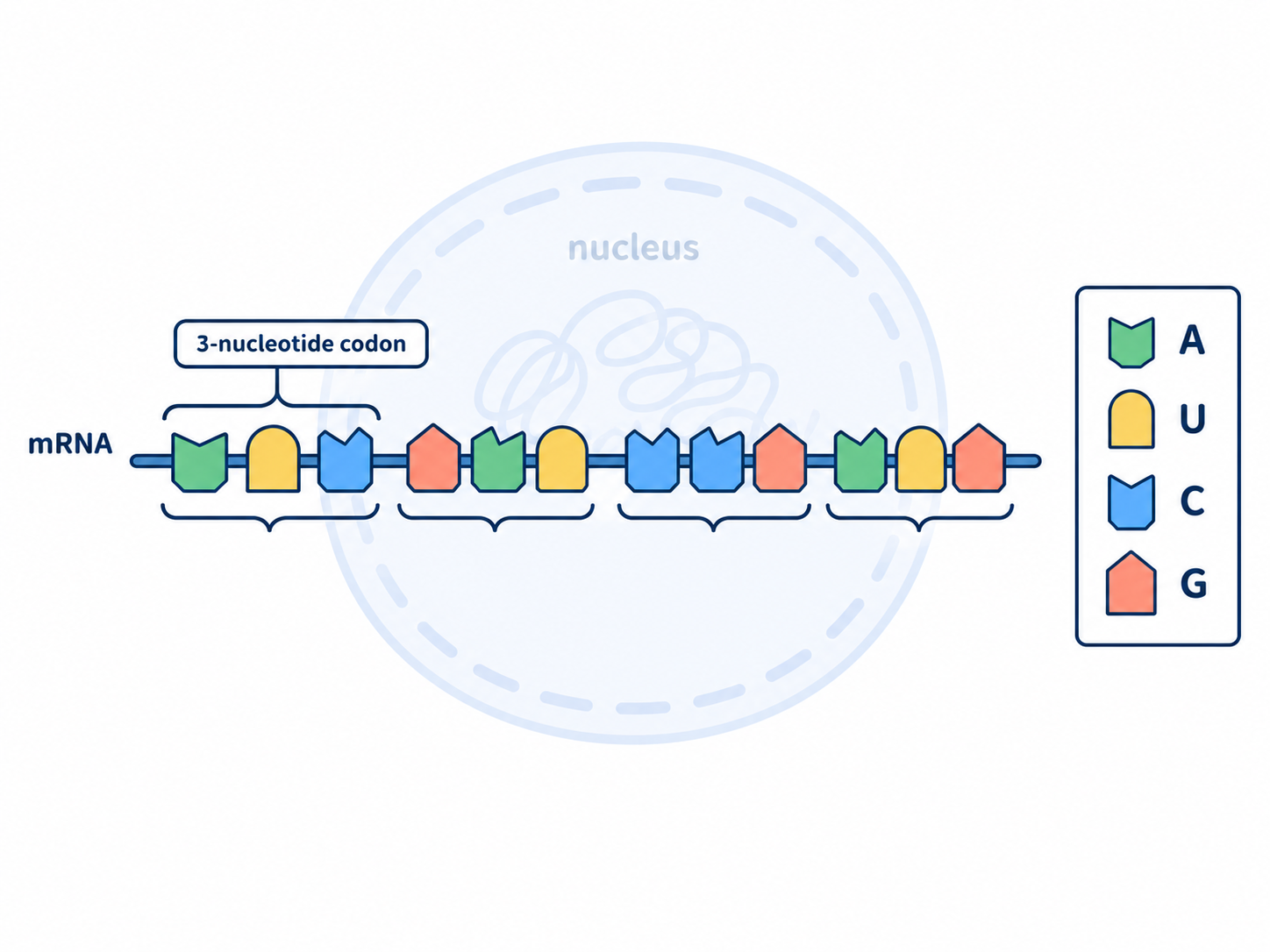
In molecular biology, genetic information in messenger RNA is read in triplets of nucleotides called codons. Each position in a 3-nucleotide codon can be occupied by any one of 4 ribonucleotide bases: Adenine (A), Uracil (U), Cytosine (C), or Guanine (G).
Principles it rests on
- Fundamental Counting Principle: When each of several stages offers an independent choice, the number of distinct outcomes grows as a product raised to the number of stages.
- Cartesian Product Cardinality: $|\mathcal{A}_1 \times \cdots \times \mathcal{A}_k| = \prod_i |\mathcal{A}_i|$ counts ordered arrangements.
- Standard Genetic Code: Translation reads messenger RNA in non-overlapping triplets; the code is degenerate, since more codons exist than the amino acids they specify.
Question
How many distinct 3-nucleotide codons can be constructed from these 4 RNA bases if bases can be repeated?
Hints
Solution
1. Define the Alphabetic State Space and Sequence Tuple:
In molecular biology and messenger RNA translation, a codon is an ordered triplet sequence of nucleotides:
$\mathbf{C} = (b_1, b_2, b_3)$
Each position $b_i$ is chosen from the alphabet of ribonucleotide bases $\mathcal{A} = \{\text{A, U, C, G}\}$.
The size of the alphabet is $n = |\mathcal{A}| = 4$, and the sequence length is $k = 3$.
2. Apply the Fundamental Counting Principle (Product Rule with Replacement):
- Position 1 ($b_1$): Can be any of the 4 bases ($\{\text{A, U, C, G}\}$) $\implies 4$ choices.
- Position 2 ($b_2$): Because bases can repeat freely (e.g. UUU encodes Phenylalanine) $\implies 4$ independent choices.
- Position 3 ($b_3$): Can also be any of the 4 bases $\implies 4$ independent choices.
The total number of distinct 3-nucleotide sequences is the cardinality of the Cartesian product $\mathcal{A} \times \mathcal{A} \times \mathcal{A}$:
$N = n_1 \times n_2 \times n_3 = 4 \times 4 \times 4 = 4^3$
3. Explicit Numerical Computation:
$4^3 = 4 \times 4 \times 4 = 16 \times 4 = 64$
4. Biological Context & Error Refutation:
- The 64 possible codons constitute the standard genetic code (61 coding codons mapping to 20 amino acids with degeneracy + 3 stop codons: UAA, UAG, UGA).
- Trap Check: If repetition were forbidden, the count would be $P(4, 3) = 4 \times 3 \times 2 = 24$, but RNA transcription allows repeated nucleotides.
- Conclusion: Exactly 64 distinct codons can be formed.
How others did
Nobody has tried this yet.Be the first. Your answer starts the stats.
Only each person's first answer, given before viewing the solution, is counted.

Discussion 0 comments
Log in to join the discussion.