Ideal Gas Molar Volume at STP

An enclosed flexible container contains $n = 1.00\text{ mole}$ of helium gas acting ideally at standard temperature $T = 273.15\text{ K}$ ($0^\circ\text{C}$) and standard pressure $P = 1.00\text{ atm}$. The universal gas constant is $R = 0.08206\text{ L}\cdot\text{atm}/(\text{mol}\cdot\text{K})$.
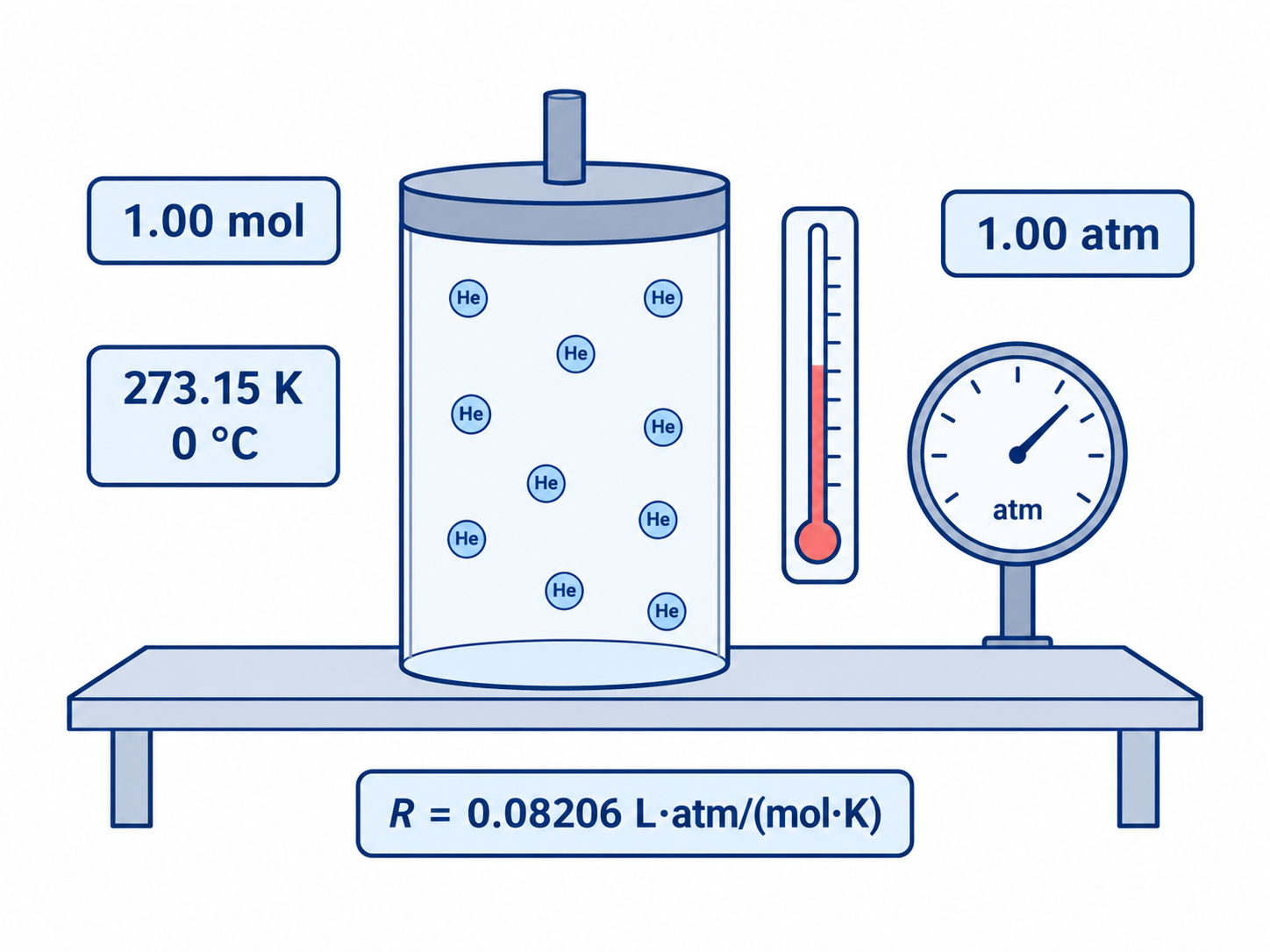
Principles it rests on
- Ideal Gas Equation of State: $P V = n R T$ relates the pressure, volume, amount, and absolute temperature of an ideal gas.
- Avogadro's Hypothesis: Equal volumes of ideal gases at the same temperature and pressure contain equal numbers of molecules.
- Standard Reference Conditions: Standard temperature and pressure are defined reference states; $T$ must be expressed in kelvin and $P$ as an absolute pressure.
Question
What volume in liters does this gas sample occupy under these standard conditions?
Hints
Solution
1. State the Ideal Gas Equation of State:
From kinetic molecular theory, ideal gas behavior is governed by:
$P V = n R T$
where $P$ is absolute pressure, $V$ is volume, $n$ is amount of gas in moles, $R$ is the universal gas constant, and $T$ is absolute thermodynamic temperature in Kelvin.
2. Identify Standard Temperature and Pressure (STP) Parameters:
- Amount of gas: $n = 1.00\text{ mol}$
- Standard Temperature: $T = 0^\circ\text{C} = 273.15\text{ K}$
- Standard Pressure: $P = 1.00\text{ atm}$
- Universal Gas Constant: $R = 0.0820574\text{ L}\cdot\text{atm}/(\text{mol}\cdot\text{K})$
3. Isolate and Calculate Molar Volume ($V$):
$V = \frac{n R T}{P}$
$V = \frac{(1.00\text{ mol}) \times \left(0.0820574\frac{\text{L}\cdot\text{atm}}{\text{mol}\cdot\text{K}}\right) \times (273.15\text{ K})}{1.00\text{ atm}}$
$V = 1.00 \times 0.0820574 \times 273.15 = 22.41398\text{ L} \approx 22.41\text{ Liters}$
4. Physical Generality & Avogadro's Hypothesis:
- Avogadro's hypothesis establishes that equal volumes of all gases at the same temperature and pressure contain equal numbers of molecules.
- Under STP conditions ($0^\circ\text{C}, 1\text{ atm}$), exactly $1.00\text{ mole}$ of any ideal gas occupies approximately 22.41 L (the standard molar volume).
- Conclusion: The gas sample occupies 22.41 L.
How others did
Nobody has tried this yet.Be the first. Your answer starts the stats.
Only each person's first answer, given before viewing the solution, is counted.

Discussion 0 comments
Log in to join the discussion.