Haber Process Le Chatelier Equilibrium Shift

The synthesis of ammonia in industrial chemistry follows the Haber-Bosch reaction:
$\text{N}_2(g) + 3\text{H}_2(g) \rightleftharpoons 2\text{NH}_3(g) \quad \Delta H^\circ = -92.4\text{ kJ/mol}$
An industrial chemical engineer wants to shift the equilibrium position to maximize the mole fraction of $\text{NH}_3$ at equilibrium.
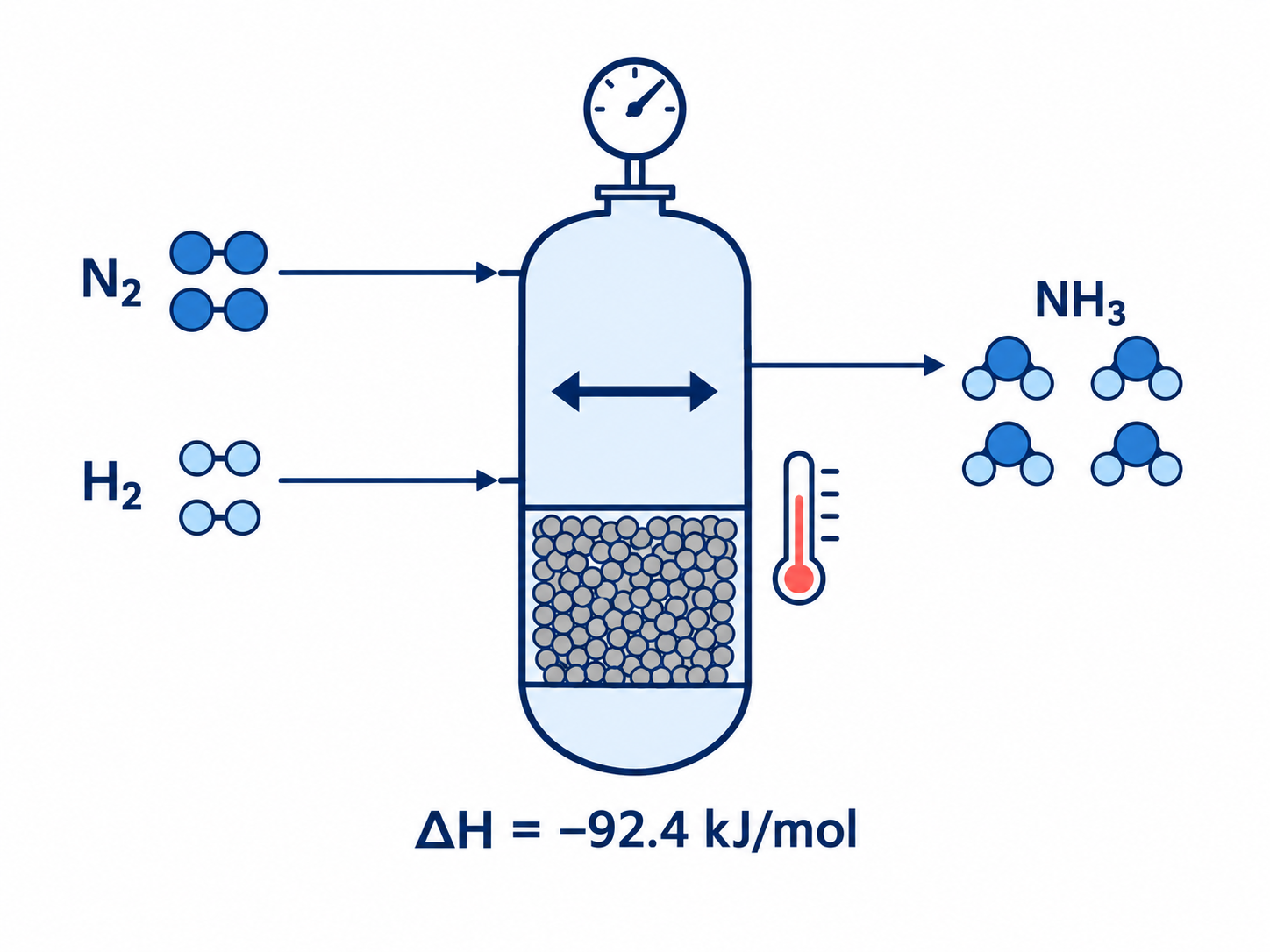
$\text{N}_2(g) + 3\text{H}_2(g) \rightleftharpoons 2\text{NH}_3(g) \quad \Delta H^\circ = -92.4\text{ kJ/mol}$
An industrial chemical engineer wants to shift the equilibrium position to maximize the mole fraction of $\text{NH}_3$ at equilibrium.
Principles it rests on
• Le Chatelier's Principle: A dynamic equilibrium shifts to counteract applied external disturbances in temperature or pressure.
• Van 't Hoff Isochore Equation: $\frac{d(\ln K_p)}{dT} = \frac{\Delta H^\circ}{R T^2}$. For exothermic reactions ($\Delta H^\circ < 0$), decreasing temperature ($T \downarrow$) increases $K_p$.
• Gaseous Partial Pressure Quotient: $\Delta n_{\text{gas}} = 2 - 4 = -2$. Increasing total pressure ($P \uparrow$) quadratically favors products ($K_x = K_p P^2$).
Question
Which combination of operational adjustments will shift the thermodynamic equilibrium toward producing the highest yield of ammonia?
Hints
Solution
Step-by-Step Chemical Thermodynamics Derivation:
1. Analyze Mole Change (Pressure Effect):
- Reactant moles of gas: $1\text{ (N}_2\text{)} + 3\text{ (H}_2\text{)} = 4\text{ moles}$.
- Product moles of gas: $2\text{ (NH}_3\text{)} = 2\text{ moles}$.
- $\Delta n_{gas} = 2 - 4 = -2$.
- Increasing total pressure compresses volume; equilibrium shifts to the side with fewer gas molecules (the right side) to relieve pressure.
2. Analyze Reaction Enthalpy (Temperature Effect):
- $\Delta H^\circ = -92.4\text{ kJ/mol} < 0$ (exothermic).
- Heat is a 'product': $\text{N}_2 + 3\text{H}_2 \rightleftharpoons 2\text{NH}_3 + \text{Heat}$.
- Lowering temperature removes heat; by Le Chatelier's principle, equilibrium shifts forward to generate heat, increasing $K_{eq}$.
Conclusion: Decreasing temperature and increasing pressure maximizes equilibrium ammonia yield.
python
import numpy as np

# Van 't Hoff Equation: d(ln K)/dT = Delta H / (R * T^2)
R = 8.314  # J / (mol*K)
delta_H = -92400  # J/mol (exothermic)

T1 = 300.0  # 300 K
T2 = 600.0  # 600 K

# ln(K2 / K1) = - (delta_H / R) * (1/T2 - 1/T1)
ln_ratio = -(delta_H / R) * (1.0/T2 - 1.0/T1)
K_ratio = np.exp(ln_ratio)

print(f'K_eq ratio K(600K) / K(300K) = {K_ratio:.2e}')
# Since delta_H < 0 and T2 > T1, K2 < K1. Lower temp -> higher K_eq
assert K_ratio < 1.0, 'K_eq must decrease at higher temperatures for exothermic reaction'

# Delta n of gas
n_reactants = 1 + 3
n_products = 2
delta_n = n_products - n_reactants
assert delta_n == -2, 'Delta n of gas must be -2'
print('Assertion PASSED: Decreasing T increases K_eq; Increasing P favors NH3 formation')
How others did
Nobody has tried this yet.Be the first. Your answer starts the stats.
Only each person's first answer, given before viewing the solution, is counted.

Discussion 0 comments
Log in to join the discussion.