Resistor Joule Power Dissipation

A direct current (DC) power supply maintains a constant potential difference of $V = 12\text{ V}$ across a heating resistor with resistance $R = 8\ \Omega$.
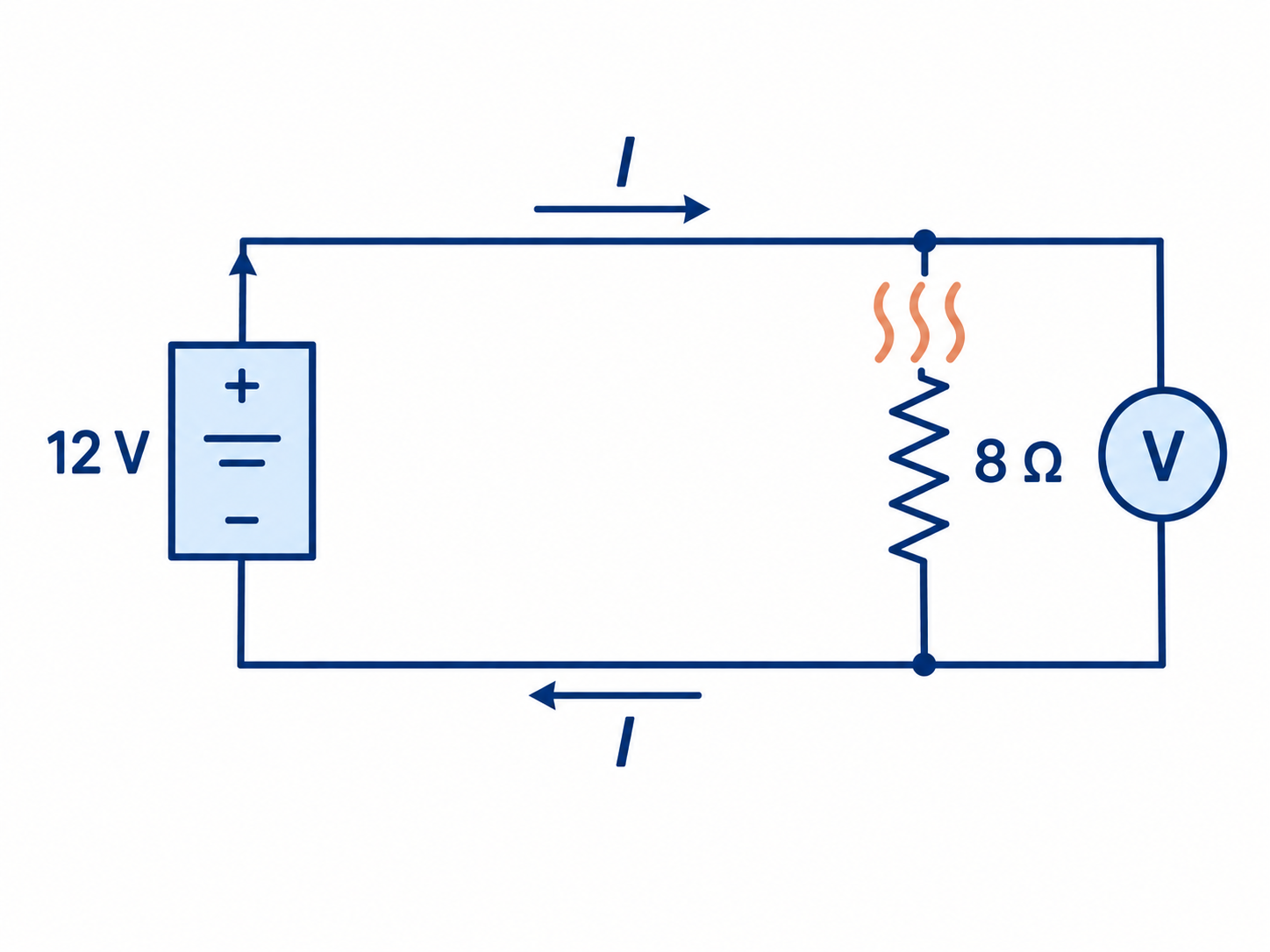
Principles it rests on
- Ohm's Law: For an ohmic conductor the current is proportional to the applied potential difference, $I = \frac{V}{R}$.
- Joule's Law of Heating: Electrical power dissipated as thermal energy is $P = V I$.
- Equivalent Forms: Power may be written in terms of voltage, current, or resistance; each form tacitly holds the remaining quantity constant.
Question
What is the electric power dissipated as heat in the resistor?
Hints
Solution
1. Define Fundamental Electric Potential and Current Relations:
- Electric potential difference $V = \frac{dW}{dq}$ represents work per unit electric charge.
- Electric current $I = \frac{dq}{dt}$ represents charge flow rate per unit time.
- Electric power $P$ delivered to a circuit component is the rate of energy dissipation:
$P = \frac{dW}{dt} = \left(\frac{dW}{dq}\right) \cdot \left(\frac{dq}{dt}\right) = V \cdot I$
2. Incorporate Ohm's Law for Resistive Heating:
For an ohmic resistor of resistance $R$, the constitutive relation is $V = I R$, or equivalently $I = \frac{V}{R}$.
Substituting $I = \frac{V}{R}$ into the power equation:
$P = V \cdot \left(\frac{V}{R}\right) = \frac{V^2}{R}$
Alternatively, substituting $V = I R$ yields Joule's first law: $P = (I R) I = I^2 R$.
3. Explicit Numerical Evaluation:
Given: $V = 12\text{ V}$ and $R = 8\ \Omega$.
$P = \frac{(12\text{ V})^2}{8\ \Omega} = \frac{144\text{ V}^2}{8\ \Omega} = 18\text{ Watts (W)}$
4. Alternative Cross-Verification via Current ($I$):
$I = \frac{V}{R} = \frac{12\text{ V}}{8\ \Omega} = 1.5\text{ A}$
$P = V \times I = 12\text{ V} \times 1.5\text{ A} = 18\text{ W}$
$P = I^2 R = (1.5\text{ A})^2 \times 8\ \Omega = 2.25 \times 8 = 18\text{ W}$
5. Dimensional Consistency Check:
$\left[\frac{\text{V}^2}{\Omega}\right] = \frac{\text{J}^2 / \text{C}^2}{\text{V} / \text{A}} = \frac{\text{J}^2 / \text{C}^2}{\text{J} / (\text{C}\cdot\text{A})} = \frac{\text{J}\cdot\text{A}}{\text{C}} = \frac{\text{J}\cdot(\text{C/s})}{\text{C}} = \frac{\text{J}}{\text{s}} = \text{W}$
- Conclusion: The electric power dissipated as heat is 18 W.
How others did
Nobody has tried this yet.Be the first. Your answer starts the stats.
Only each person's first answer, given before viewing the solution, is counted.


Discussion 0 comments
Log in to join the discussion.