Rocket Sled Acceleration

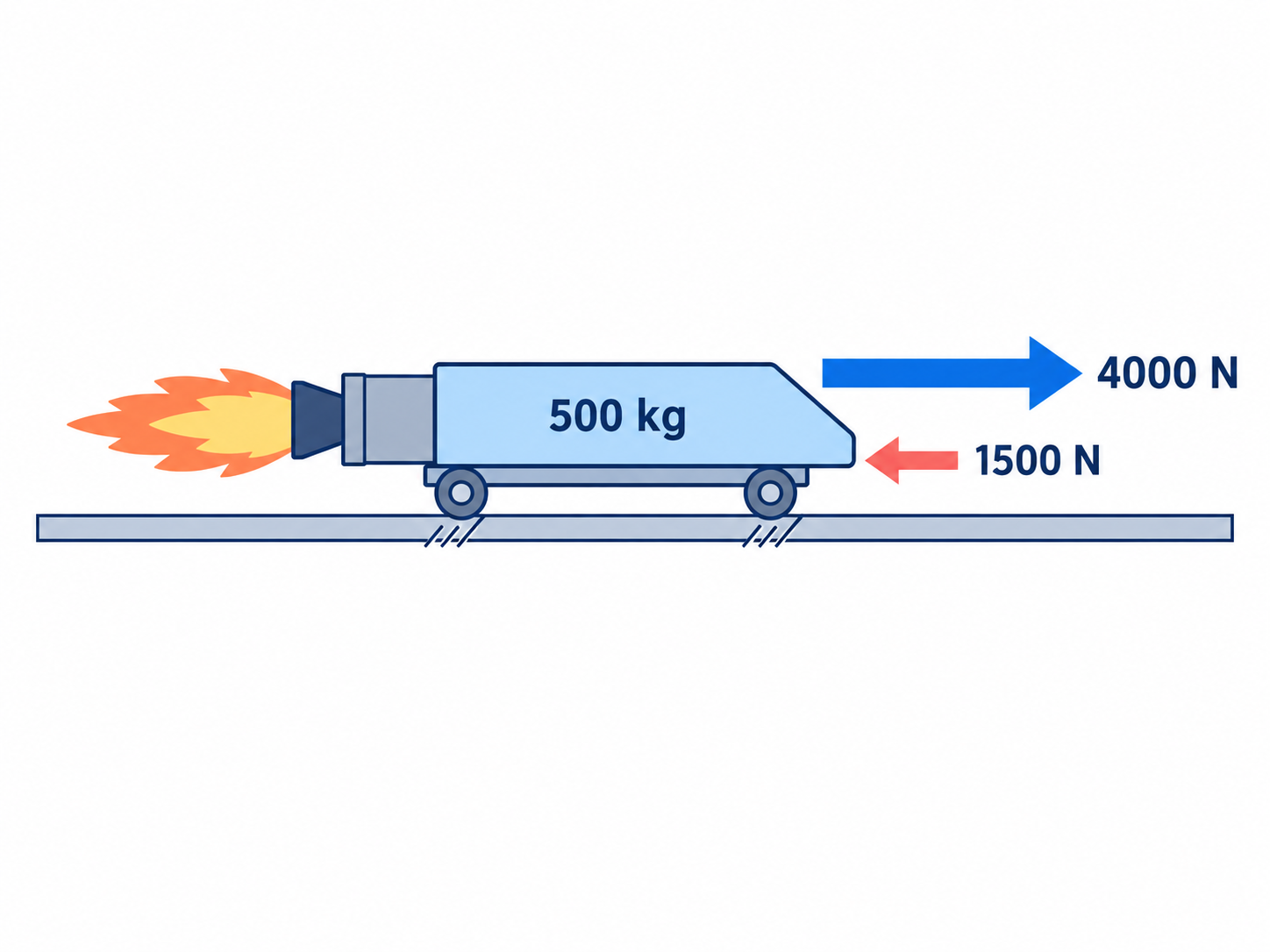
A test rocket sled with a total mass of $500\text{ kg}$ is fired horizontally along a straight track. The solid rocket motor generates a constant forward thrust of $4000\text{ N}$. Track friction and aerodynamic drag exert a constant opposing resistive force of $1500\text{ N}$.
Principles it rests on
- Newton's Second Law: $\vec{a} = \frac{\vec{F}_{\text{net}}}{m}$, where $\vec{F}_{\text{net}}$ is the vector sum of all forces acting on the body.
- Free-Body Diagrams: Isolate the object of interest and account for every interaction that acts on it, including contact and resistive forces.
- Constant Net Force: A resultant force that is constant in magnitude and direction produces uniform acceleration.
Question
What is the magnitude of the horizontal acceleration of the rocket sled during this burn phase?
Hints
Solution
1. Define the Free-Body Diagram and Coordinate Frame:
Let the horizontal track direction be the $+x$ axis.
- Total mass of the rocket sled: $m = 500\text{ kg}$.
- Forward applied thrust force vector: $\mathbf{F}_{\text{thrust}} = +4000\,\hat{\mathbf{i}}\text{ N}$.
- Opposing resistive force vector (friction + aerodynamic drag): $\mathbf{F}_{\text{resistive}} = -1500\,\hat{\mathbf{i}}\text{ N}$.
2. Compute Net Horizontal Force ($F_{\text{net}}$):
By vector addition of collinear forces along the $x$-axis:
$F_{\text{net}} = \sum F_x = F_{\text{thrust}} - F_{\text{resistive}}$
$F_{\text{net}} = 4000\text{ N} - 1500\text{ N} = 2500\text{ N}$
3. Apply Newton's Second Law of Motion ($F_{\text{net}} = m a$):
Rearranging for horizontal acceleration $a$:
$a = \frac{F_{\text{net}}}{m}$
4. Explicit Numerical Evaluation and Unit Check:
$a = \frac{2500\text{ N}}{500\text{ kg}} = \frac{2500\text{ kg}\cdot\text{m/s}^2}{500\text{ kg}} = 5.0\text{ m/s}^2$
5. Physical Sanity Check & Component Verification:
- Sled acceleration from thrust alone: $a_{\text{gross}} = \frac{4000}{500} = 8.0\text{ m/s}^2$.
- Deceleration from drag alone: $a_{\text{drag}} = \frac{1500}{500} = 3.0\text{ m/s}^2$.
- Net acceleration: $a = 8.0 - 3.0 = 5.0\text{ m/s}^2$.
- Conclusion: The magnitude of the horizontal acceleration is $5.0\text{ m/s}^2$.
How others did
Nobody has tried this yet.Be the first. Your answer starts the stats.
Only each person's first answer, given before viewing the solution, is counted.




Discussion 0 comments
Log in to join the discussion.