Mendelian Pea Plant Monohybrid Cross
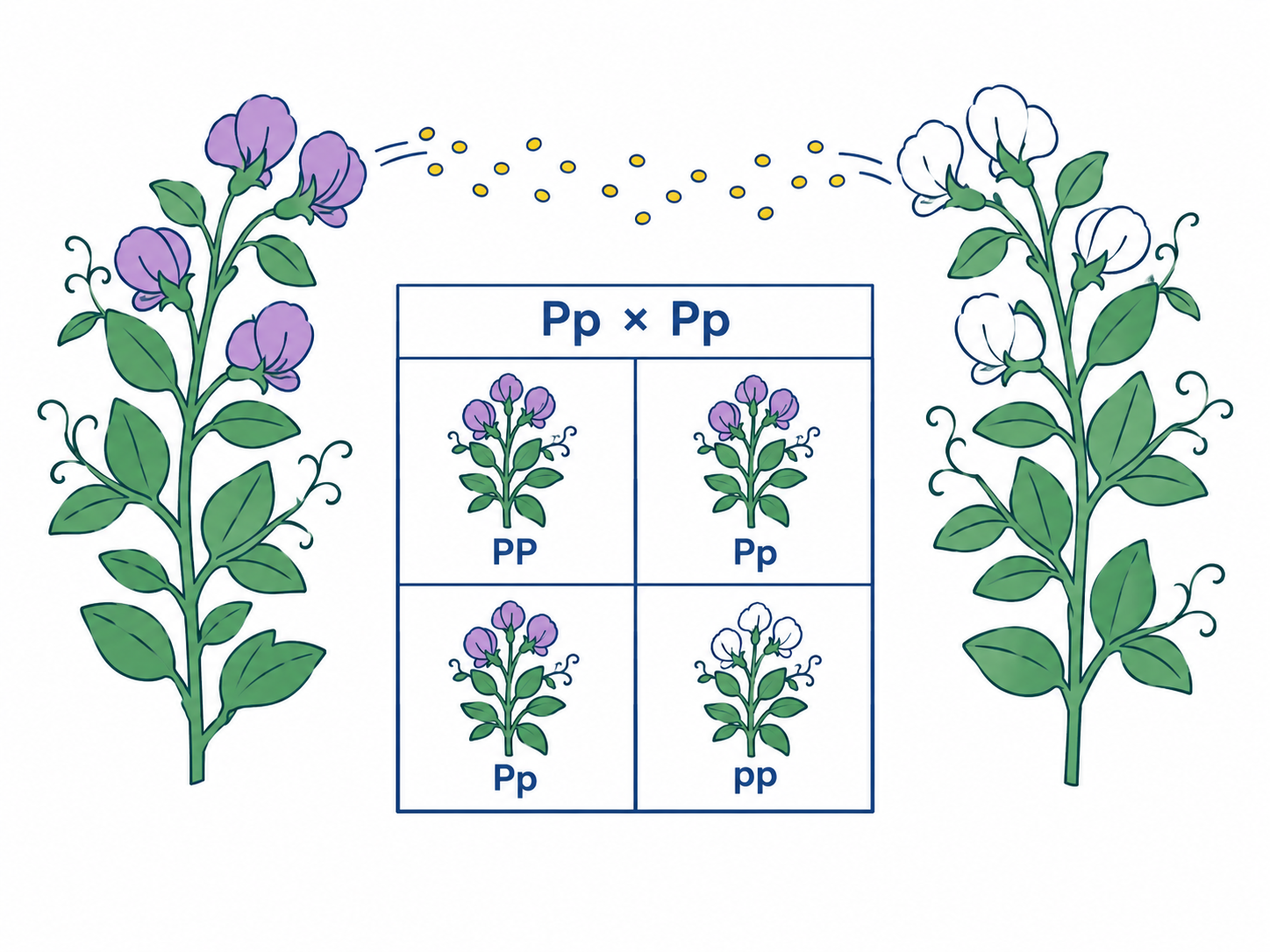
In Mendel's garden pea experiments, the allele for purple flower color ($P$) is completely dominant over the allele for white flower color ($p$). Two heterozygous purple-flowered pea plants ($Pp \times Pp$) are cross-pollinated.
Principles it rests on
- Mendel's Law of Segregation: The two alleles of a gene separate during gamete formation, so each gamete receives one allele with equal probability.
- Punnett Square Enumeration: A Punnett square pairs every possible gamete from each parent to enumerate the zygote genotypes and their relative proportions.
- Complete Dominance: A dominant allele is expressed in the phenotype whenever at least one copy is present, so multiple genotypic classes map to a single phenotype.
Question
What is the expected theoretical probability (percentage) that an offspring plant will have purple flowers?
Hints
Solution
1. Define Alleles and Parental Genotypes:
Let the flower color locus have two alleles:
- $P$: Dominant allele for purple flowers
- $p$: Recessive allele for white flowers
Both parent plants are heterozygous: Parent 1 ($Pp$) $\times$ Parent 2 ($Pp$).
2. Apply Mendel's First Law (Law of Segregation):
During meiosis and gametogenesis, the two alleles at a locus segregate independently with equal probability:
- Parent 1 gametes: $P(P) = 0.5$, $P(p) = 0.5$.
- Parent 2 gametes: $P(P) = 0.5$, $P(p) = 0.5$.
3. Construct the $2 \times 2$ Punnett Square Matrix:
The fertilization events combine independent gametes:
- $P \times P \to PP$ (Homozygous dominant, probability $0.5 \times 0.5 = 0.25 = 25\%$)
- $P \times p \to Pp$ (Heterozygous, probability $0.5 \times 0.5 = 0.25 = 25\%$)
- $p \times P \to pP$ (Heterozygous, probability $0.5 \times 0.5 = 0.25 = 25\%$)
- $p \times p \to pp$ (Homozygous recessive, probability $0.5 \times 0.5 = 0.25 = 25\%$)
Genotypic distribution: $1 PP : 2 Pp : 1 pp$ (or $25\% PP, 50\% Pp, 25\% pp$).
4. Map Genotypes to Phenotypes via Complete Dominance:
Under complete dominance, the presence of at least one dominant allele $P$ results in purple flowers:
- $\text{Phenotype}(PP) = \text{Purple}$
- $\text{Phenotype}(Pp) = \text{Purple}$
- $\text{Phenotype}(pp) = \text{White}$
Summing the probabilities for purple-flowered offspring:
$P(\text{Purple}) = P(PP) + P(Pp) = \frac{1}{4} + \frac{2}{4} = \frac{3}{4} = 0.75 = 75\%$
$P(\text{White}) = P(pp) = \frac{1}{4} = 0.25 = 25\%$
Phenotypic ratio: $3\text{ Purple} : 1\text{ White}$.
5. Refutation of Common Misconceptions:
- $50\%$ is the frequency of the heterozygous genotype ($Pp$) alone, not the purple phenotype.
- Conclusion: The expected probability of purple-flowered offspring is 75%.
How others did
Nobody has tried this yet.Be the first. Your answer starts the stats.
Only each person's first answer, given before viewing the solution, is counted.



Discussion 0 comments
Log in to join the discussion.