Oxygen Production in Photosynthesis

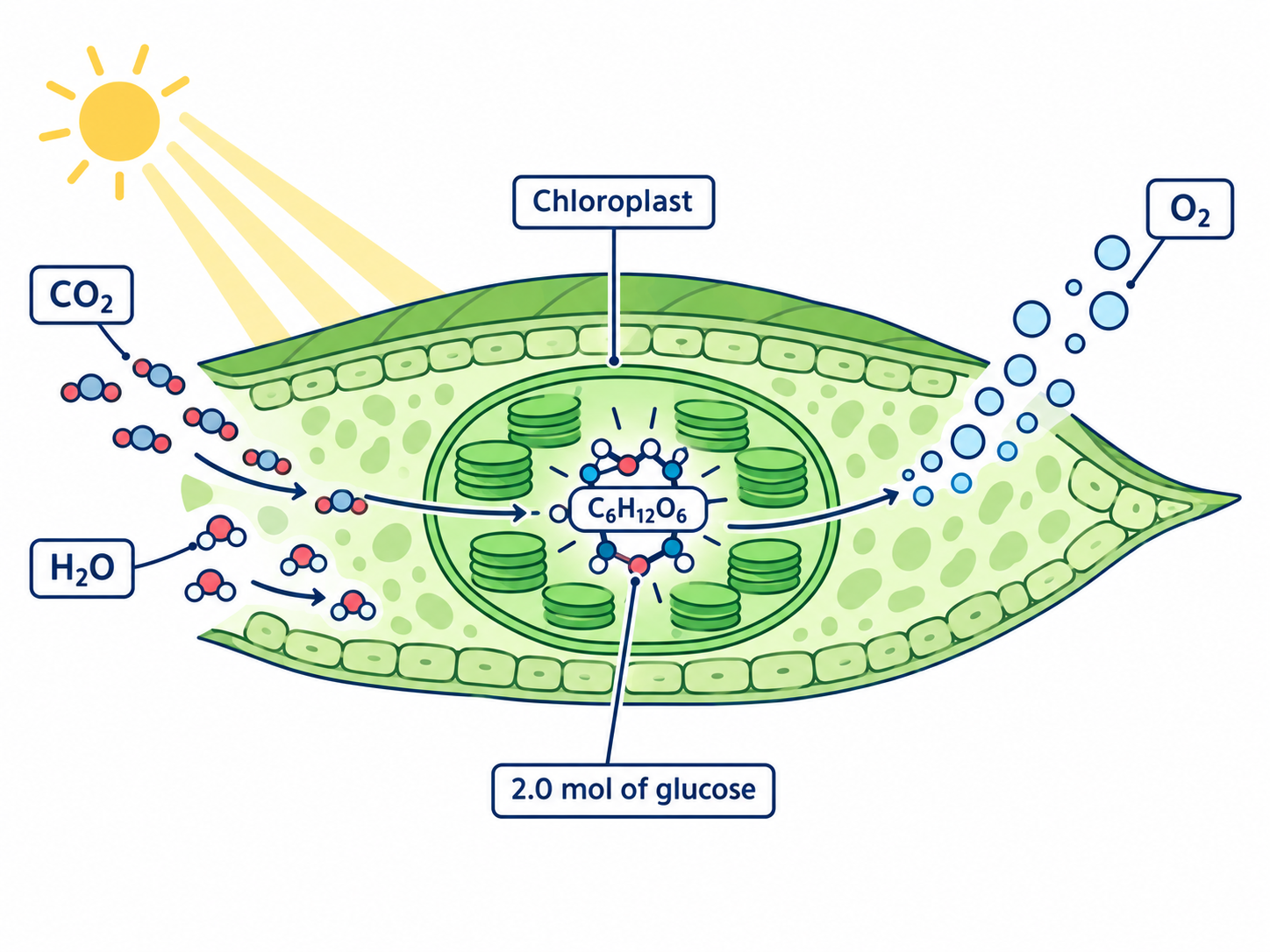
The overall balanced chemical equation for oxygenic photosynthesis in plant chloroplasts is:
$6\text{CO}_2 + 6\text{H}_2\text{O} + \text{photons} \to \text{C}_6\text{H}_{12}\text{O}_6 + 6\text{O}_2$
$6\text{CO}_2 + 6\text{H}_2\text{O} + \text{photons} \to \text{C}_6\text{H}_{12}\text{O}_6 + 6\text{O}_2$
Principles it rests on
- Balanced Reaction Stoichiometry: Moles of reactant consumed and product formed are proportional to the coefficients of the balanced equation.
- Coefficient Ratio Conversions: Amounts of two species in the same reaction are related by the ratio of their stoichiometric coefficients.
- Sources of Released Oxygen: The $\text{O}_2$ liberated in oxygenic photosynthesis originates from the photolytic splitting of water in photosystem II.
Question
How many moles of oxygen gas ($\text{O}_2$) are released into the atmosphere for every $2.0\text{ moles}$ of glucose ($\text{C}_6\text{H}_{12}\text{O}_6$) synthesized?
Hints
Solution
1. Analyze the Balanced Overall Photosynthesis Equation:
In oxygenic photosynthetic organisms (plants and cyanobacteria), the light-dependent and light-independent (Calvin cycle) reactions sum to:
$6\text{CO}_2(g) + 6\text{H}_2\text{O}(l) + \text{photons} \to 1\text{C}_6\text{H}_{12}\text{O}_6(s) + 6\text{O}_2(g)$
2. Determine the Fundamental Stoichiometric Molar Ratio:
The stoichiometric coefficients define the exact molar conversion ratio between glucose synthesized and oxygen gas released:
$\text{Molar Ratio} = \frac{6\text{ moles of } \text{O}_2}{1\text{ mole of } \text{C}_6\text{H}_{12}\text{O}_6}$
3. Compute Oxygen Yield for $2.00\text{ Moles}$ of Glucose:
Given amount of synthesized glucose: $n(\text{Glucose}) = 2.00\text{ mol}$.
Multiplying by the stoichiometric ratio:
$n(\text{O}_2) = n(\text{Glucose}) \times \left(\frac{6\text{ mol } \text{O}_2}{1\text{ mol Glucose}}\right) = 2.00\text{ mol} \times 6 = 12.0\text{ moles of } \text{O}_2$
4. Biochemical Origin of Atmospheric Oxygen:
- In the light-dependent reactions within thylakoid membranes, Photosystem II (PSII) extracts electrons via the photolysis of water: $2\text{H}_2\text{O} \to \text{O}_2 + 4\text{H}^+ + 4e^-$.
- To synthesize 1 mole of hexose glucose, 6 moles of $\text{O}_2$ are generated from the photolysis of 12 water molecules.
- For 2.0 moles of glucose, exactly $2 \times 6 = 12.0$ moles of $\text{O}_2$ gas are released.
- Conclusion: 12.0 moles of $\text{O}_2$ are released into the atmosphere.
How others did
Nobody has tried this yet.Be the first. Your answer starts the stats.
Only each person's first answer, given before viewing the solution, is counted.


Discussion 0 comments
Log in to join the discussion.