Is Thomson's lamp on or off?

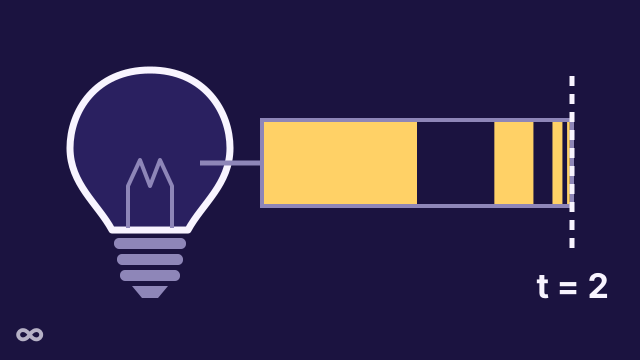
A lamp has a single button that switches it between on and off. At $t = 0$ the lamp is on.
After $1$ minute you press the button. After another $\tfrac12$ minute you press it again, then after another $\tfrac14$ minute, then $\tfrac18$, and so on, halving the wait each time.
The waits add up to $1 + \tfrac12 + \tfrac14 + \dots = 2$ minutes, so infinitely many presses are done by $t = 2$ minutes. The philosopher J. F. Thomson described this lamp in 1954.
Principles it rests on
- A sequence that keeps alternating, such as $1, 0, 1, 0, \dots$, has no limit.
- Grandi's series $1 - 1 + 1 - 1 + \dots$ diverges: its partial sums alternate between 1 and 0.
- A description of every moment before a time $T$ does not, on its own, fix what happens at $T$.
Question
What state is the lamp in at exactly $t = 2$ minutes?
Hints
Solution
The states before 2 minutes. Write 1 for on and 0 for off. After $0, 1, 2, 3, \dots$ presses the lamp is in state
\[ 1, 0, 1, 0, 1, 0, \dots \]
These are exactly the partial sums of Grandi's series $1 - 1 + 1 - 1 + \dots$. The sequence keeps alternating, so it has no limit and the series has no sum.
Why a limit can't settle it. When the values of an infinite process converge, such as the positions of a body covering a convergent series of distances, the limit tells us the state when the steps end. Here the states don't converge, so there is no value that continuity could hand on to $t = 2$.
Thomson's argument and the reply. Thomson argued that the lamp must be on or off at 2 minutes, yet neither answer is possible, so a supertask (completing infinitely many actions) is impossible. Paul Benacerraf replied in 1962 that the story only fixes the lamp's state at every time before 2 minutes. The state at $t = 2$ is a separate fact that the story doesn't mention, so on, off, or even a broken bulb are all consistent with it. There is no contradiction, only a missing piece of information.
A tempting wrong answer. Grandi's series can be given the value $\tfrac12$ by Cesàro averaging, the average of its partial sums. That is a summation convention, not a physical state, and it doesn't make the lamp "half on".
So the description doesn't determine the lamp's state at $t = 2$.
Sources & evidence
- Thomson's lamp: https://en.wikipedia.org/wiki/Thomson%27s_lamp
- Supertasks (Stanford Encyclopedia of Philosophy): https://plato.stanford.edu/entries/spacetime-supertasks/
- Grandi's series: https://en.wikipedia.org/wiki/Grandi%27s_series
How others did
Nobody has tried this yet.Be the first. Your answer starts the stats.
Only each person's first answer, given before viewing the solution, is counted.





Discussion 0 comments
Log in to join the discussion.