Where does guest 5 sleep in Hilbert's Hotel?


Hilbert's Hotel has infinitely many rooms, numbered $1, 2, 3, \dots$, and every room is occupied.
A bus arrives carrying infinitely many new guests, numbered $1, 2, 3, \dots$. The manager has a plan:
- First, every current guest moves from room $n$ to room $2n$, all at the same time.
- Then the new guests take the rooms left empty, in order: new guest 1 takes the lowest empty room, new guest 2 the next lowest, and so on.
Principles it rests on
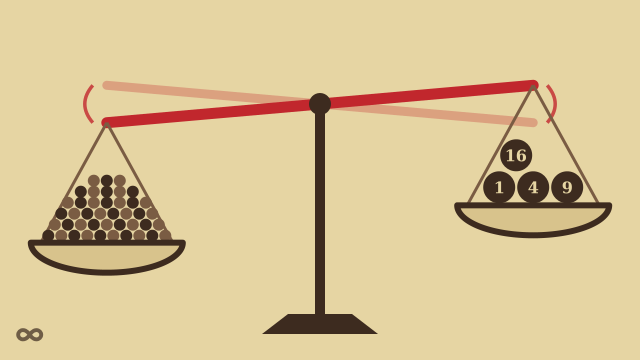
- Two sets have the same size when their members can be paired off one-to-one.
- An infinite set can be paired one-to-one with a part of itself. Richard Dedekind used this as the definition of an infinite set.
- For infinite sets, "full" no longer means "no room for more".
Question
Which room does new guest number 5 get?
Hints
Solution
After the move. The guest from room $n$ goes to room $2n$, so the occupied rooms are exactly the even ones: $2, 4, 6, \dots$ Nobody has to share, because different $n$ give different $2n$.
The empty rooms. That leaves the odd rooms empty: $1, 3, 5, 7, 9, \dots$ New guest $k$ takes the $k$th odd room, room $2k - 1$. So new guest 5 gets room $2 \cdot 5 - 1 = 9$.
Everyone fits. The old guests fill the even rooms and the new guests fill the odd rooms. Every room is used exactly once, and every guest, old or new, has a room.
Why this is a paradox. In a finite hotel, "every room is occupied" means there is no room for anyone else. In Hilbert's Hotel, a full hotel takes infinitely many new guests without anyone leaving. The old guests alone can be paired one-to-one with only the even rooms, a part of the hotel, which no finite collection allows.
David Hilbert used this story in lectures in the 1920s to show how infinite collections behave. Some philosophers use it to argue that an actually infinite collection could never exist in the real world. Mathematicians reply that it only shows infinite sets follow different rules from finite ones, not that they are contradictory.
Sources & evidence
- Hilbert's paradox of the Grand Hotel: https://en.wikipedia.org/wiki/Hilbert%27s_paradox_of_the_Grand_Hotel
- Dedekind-infinite set: https://en.wikipedia.org/wiki/Dedekind-infinite_set
How others did
Nobody has tried this yet.Be the first. Your answer starts the stats.
Only each person's first answer, given before viewing the solution, is counted.



Discussion 0 comments
Log in to join the discussion.