Which number is missing from the list?

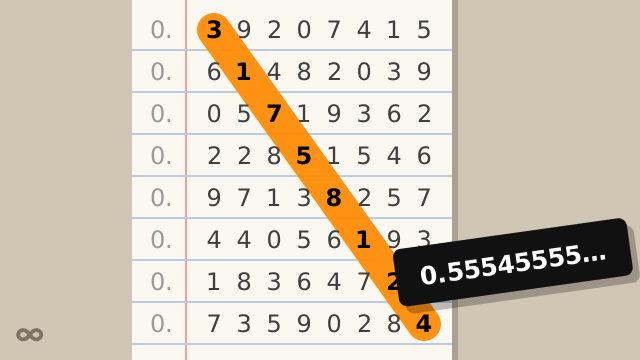
Someone claims to have a list of every real number between 0 and 1, written as infinite decimals. The list starts:
\[ \begin{aligned} r_1 &= 0.\underline{5}105\dots \\ r_2 &= 0.4\underline{1}32\dots \\ r_3 &= 0.82\underline{4}7\dots \\ r_4 &= 0.233\underline{4}\dots \end{aligned} \]
Cantor's diagonal argument builds a number $d$ that cannot be anywhere on the list. The $n$th decimal digit of $d$ is chosen by looking at the $n$th digit of $r_n$, shown underlined: if that digit is 5, write 4; otherwise, write 5.
Principles it rests on
- A set is countable if its members can be listed as a first, second, third, … with every member somewhere on the list.
- Two decimals that differ in some digit are different numbers, provided neither ends in an endless run of 9s.
- The real numbers are uncountable: they form a strictly larger infinity than the whole numbers.
Question
What does $d$ start with?
Hints
Solution
Building d. The underlined diagonal digits are $5, 1, 4, 4$. Applying the rule (5 becomes 4, anything else becomes 5):
\[ 5 \to 4, \qquad 1 \to 5, \qquad 4 \to 5, \qquad 4 \to 5, \]
so $d = 0.4555\dots$
Why d is not on the list. Could $d$ be $r_n$ for some $n$? No: by construction, the $n$th digit of $d$ differs from the $n$th digit of $r_n$. So $d$ differs from $r_1$ in the first place, from $r_2$ in the second, and so on, for every number on the list, however long it is.
The rule uses only the digits 4 and 5. That avoids a technicality: some numbers have two decimal forms, like $0.4999\dots = 0.5000\dots$, and those always involve endless 0s or 9s.
The conclusion. The argument works for any list whatsoever. Given any attempt to list the real numbers, it produces a real number the list missed. So the real numbers can't be listed at all: they are uncountable, a larger infinity than the whole numbers.
The philosophical fallout. Cantor published the argument in 1891, and it divided mathematicians. Some, like Leopold Kronecker, rejected completed infinite collections altogether. Others welcomed it. David Hilbert declared: "No one shall expel us from the paradise that Cantor has created." The same diagonal idea later reappeared in Gödel's incompleteness theorems and in Turing's proof that some problems can't be solved by any computer.
Sources & evidence
- Cantor's diagonal argument: https://en.wikipedia.org/wiki/Cantor%27s_diagonal_argument
- Uncountable set: https://en.wikipedia.org/wiki/Uncountable_set
How others did
Nobody has tried this yet.Be the first. Your answer starts the stats.
Only each person's first answer, given before viewing the solution, is counted.





Discussion 0 comments
Log in to join the discussion.