Are there fewer square numbers than whole numbers?

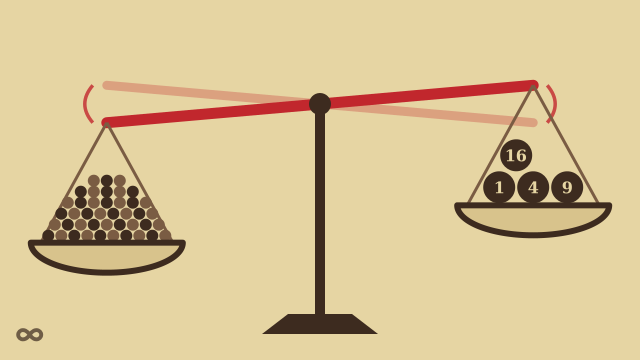
In 1638 Galileo noticed a puzzle about the perfect squares
\[ 1, 4, 9, 16, 25, \dots \]
Most whole numbers are not squares, and the squares get rarer the higher you count. Among the first 100 whole numbers only 10 are squares; among the first 10,000 only 100 are. So there seem to be far fewer squares than whole numbers.
Yet every whole number $n$ has exactly one square, $n^2$, and every square comes from exactly one whole number:
\[ 1 \leftrightarrow 1, \quad 2 \leftrightarrow 4, \quad 3 \leftrightarrow 9, \quad 4 \leftrightarrow 16, \quad \dots \]
So there also seem to be exactly as many squares as whole numbers.
Principles it rests on
- Two sets have the same size (cardinality) when there is a one-to-one pairing between them, with nothing missed and nothing repeated.
- For finite sets, "a part is smaller than the whole" always holds. For infinite sets it can fail.
- The density of a subset is a different measure from its size.
Question
Comparing the two sets by size, as modern set theory does, which statement is correct?
Hints
Solution
Size by pairing. Cantor defined two sets to be the same size when their members can be paired one-to-one, with nothing left over on either side. This is how we compare finite sets without counting: if every person has a chair and every chair has a person, there are as many chairs as people.
The pairing works. The rule $n \leftrightarrow n^2$ gives every whole number exactly one square. Every square $m^2$ is matched to exactly one whole number, $m$. Nothing is missed and nothing is used twice. So the squares and the whole numbers are the same size. Both are countably infinite, of size $\aleph_0$.
Why intuition disagrees. For finite sets, three ideas always agree:
For infinite sets these ideas come apart, and we have to choose which one to call "size". Mathematics chooses pairing. It keeps "thinning out" as a separate idea: the squares have density $0$ among the whole numbers, even though there are just as many of them.
Galileo concluded that "equal", "greater" and "less" simply don't apply to infinite collections. Cantor kept them, defined them by pairing, and found that the real numbers form a strictly larger infinity than the whole numbers.
The pairing works. The rule $n \leftrightarrow n^2$ gives every whole number exactly one square. Every square $m^2$ is matched to exactly one whole number, $m$. Nothing is missed and nothing is used twice. So the squares and the whole numbers are the same size. Both are countably infinite, of size $\aleph_0$.
Why intuition disagrees. For finite sets, three ideas always agree:
- two sets that pair one-to-one are the same size;
- a part is smaller than the whole (Euclid's "the whole is greater than the part");
- a set that thins out has fewer members.
For infinite sets these ideas come apart, and we have to choose which one to call "size". Mathematics chooses pairing. It keeps "thinning out" as a separate idea: the squares have density $0$ among the whole numbers, even though there are just as many of them.
Galileo concluded that "equal", "greater" and "less" simply don't apply to infinite collections. Cantor kept them, defined them by pairing, and found that the real numbers form a strictly larger infinity than the whole numbers.
Sources & evidence
- Galileo's paradox: https://en.wikipedia.org/wiki/Galileo%27s_paradox
- Cardinality: https://en.wikipedia.org/wiki/Cardinality
How others did
Nobody has tried this yet.Be the first. Your answer starts the stats.
Only each person's first answer, given before viewing the solution, is counted.



Discussion 0 comments
Log in to join the discussion.